Mobile yard handling is not simply a matter of lifting a heavy load from one point to another. In many container terminals, precast yards, shipyards, and industrial storage areas, the handling equipment must also move around the yard, access different storage positions, and work efficiently when the layout changes.
Two common solutions are straddle carriers and gantry cranes. Both can lift and transport heavy loads, but they approach the job in very different ways.
A straddle carrier carries the load within its own frame and travels directly on its wheels. A gantry crane, by contrast, normally lifts the load with a trolley and moves along a defined runway or rail system. Some mobile gantry cranes can travel on wheels, but their lifting operation is still based on a gantry structure rather than carrying the load inside the frame.
For yards where mobility and route flexibility are the main concerns, a straddle carrier can have a clear advantage. However, a gantry crane may be the better choice when the handling area is fixed and high lifting capacity, stacking height, or precise positioning is more important.
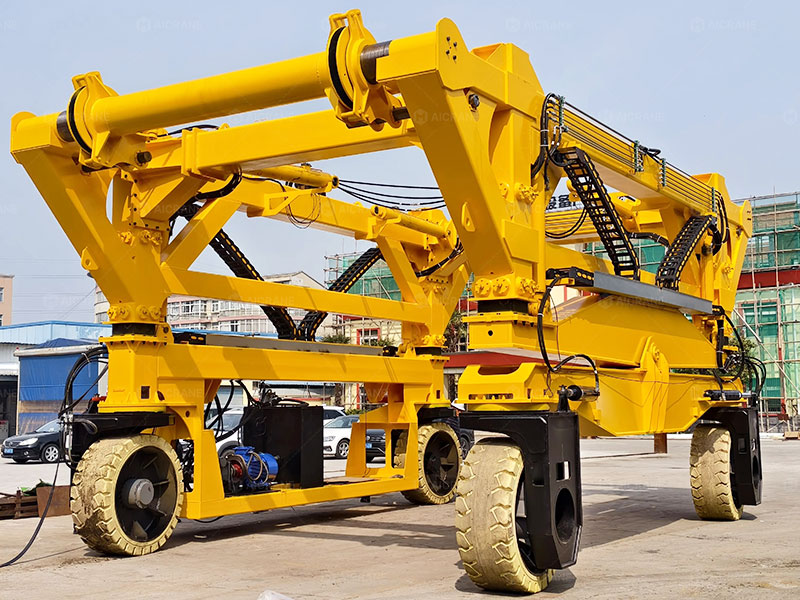
How Straddle Carriers and Gantry Cranes Handle Loads Differently
The biggest difference is how the machine interacts with the load.
A straddle carrier drives over or around the load and lifts it between its legs using a spreader, lifting beam, or other load-handling attachment. Once the load is suspended, the entire machine can travel to another location.
For example, a 40-ton straddle carrier handling a heavy industrial module can pick up the load near a fabrication workshop, drive across the yard, and place it beside an assembly area without requiring a fixed crane runway between the two points.
A gantry crane normally works from above. Its supporting legs carry the crane structure, while the trolley travels along the main girder. The crane can lift and move a load horizontally within its working envelope, but its movement is generally restricted to the crane’s travel path.
This distinction becomes important when the yard has several changing transport routes.
If loads need to move from A to B, then B to C, and later from C to a completely different storage area, a straddle carrier does not need new rails or a new runway. It simply changes direction and follows the required route.
A fixed gantry crane cannot provide the same freedom unless its supporting system has been specifically designed for that operating area.
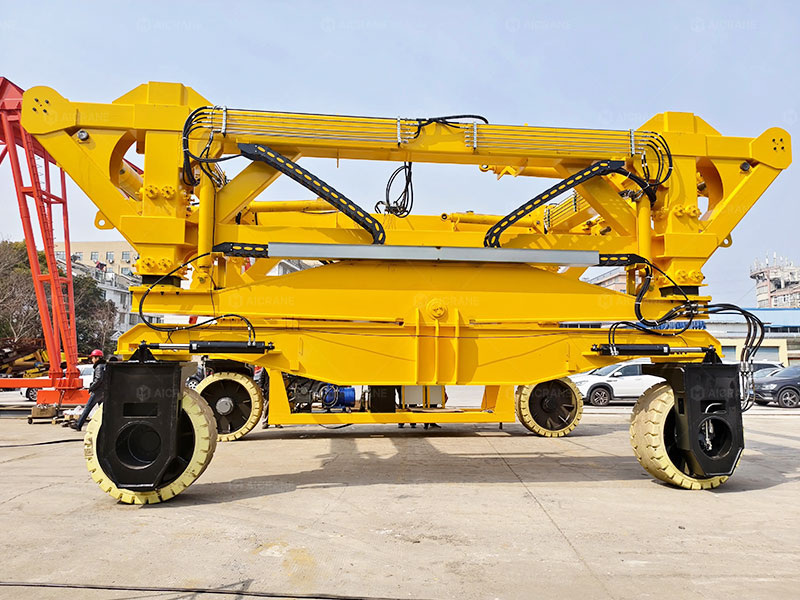
When a Straddle Carrier Is Better for Mobile Yard Handling
A straddle carrier is particularly useful when the main requirement is transport plus lifting in the same machine.
Consider a precast concrete yard producing bridge beams. A finished beam may need to be lifted from the production area, transported to a storage position, and later moved to a loading zone.
With a conventional overhead or gantry crane, the crane must have access to each location along its runway. If the storage yard extends beyond the crane’s coverage, another transport method is needed.
A straddle carrier can perform these steps as one operation. It can lift the beam, travel with it, and place it directly at the required storage position.
The same principle applies to shipyards. Large hull blocks and shipbuilding components are often moved between fabrication, blasting, painting, assembly, and storage areas. These locations do not always form a straight line.
A straddle carrier can follow the actual yard route rather than being restricted to a predetermined crane runway.
This makes it particularly attractive when:
- Storage positions change frequently.
- Loads must move between multiple workshops.
- The yard has several independent work zones.
- New production areas may be added later.
- Fixed rail infrastructure would interfere with other vehicles.
- The same machine must both lift and transport the load.
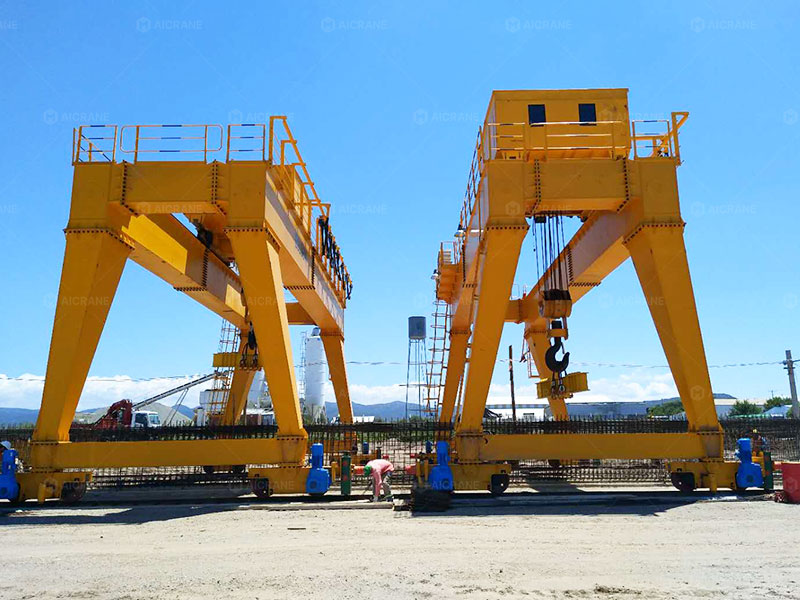
When a Gantry Crane Is Better
The mobility advantage of a straddle carrier does not mean it is automatically the better machine.
A gantry crane can be more effective when the work area is clearly defined and repetitive.
For example, consider a steel fabrication yard where steel plates and structural components are stored in fixed rows. If materials are consistently moved within one rectangular working area, a gantry crane running along established rails can cover the required storage positions without needing to drive around the yard.
A gantry crane can also provide advantages in lifting height and heavy-duty lifting configurations.
For extremely heavy loads, a double-girder gantry crane can be designed with large lifting capacities and long spans. The crane structure remains supported by its legs and does not have to carry the entire load while traveling on rubber tires.
This can make the gantry crane a better fit for operations where:
- Loads remain inside one defined work zone.
- The same lifting routes are used repeatedly.
- High lifting capacity is required.
- High lifting height is important.
- Precise positioning is needed.
- Long operating hours justify fixed infrastructure.
- The yard layout is stable for many years.
In other words, a gantry crane is often strongest when the yard itself is stable and predictable.
Straddle Carrier vs. Gantry Crane for Changing Yard Layouts
Yard layout is one of the most important factors that is sometimes overlooked during equipment selection.
A fixed gantry crane effectively defines the area where lifting can take place. Changing that area later can involve structural modifications, rail extensions, electrical work, and civil construction.
A straddle carrier does not impose the same physical limitation.
Suppose a manufacturer starts with a 5,000 m² storage yard and later adds another production building 100 meters away. If the handling equipment is a rail-mounted gantry crane designed for the original yard, extending its operating area may require additional rails and structural work.
A straddle carrier can potentially serve the new area simply by driving there, provided the pavement, turning radius, load requirements, and route clearance are suitable.
This is one reason mobile equipment can be attractive for expanding industrial operations.
However, mobility also creates requirements that a fixed gantry crane may not have. The yard needs suitable pavement strength, sufficient turning space, clear travel lanes, and safe separation between the carrier and other vehicles.
Yard Surface and Infrastructure Requirements
Infrastructure requirements can significantly influence the final choice.
A gantry crane usually needs foundations, rails, runway beams, power supply arrangements, and associated civil works. For a permanent yard with heavy production volumes, this infrastructure can be justified.
A straddle carrier requires a different type of infrastructure.
The travel surface must support the wheel loads generated by the fully loaded machine. Drainage, pavement quality, gradients, lane width, and surface flatness all matter.
For example, a carrier lifting a 40-ton load does not simply impose a 40-ton load on the ground. The machine itself also has substantial dead weight, and the total load is distributed through its wheels. The engineering team therefore needs to evaluate the actual wheel loads and ground conditions rather than judging suitability from rated lifting capacity alone.
This is particularly important for precast yards and heavy industrial yards where concrete pavement may have been designed for trucks but not necessarily for concentrated loads from a heavy straddle carrier.
Operating Flexibility and Traffic Management
Another important difference is traffic interaction.
A straddle carrier operates more like a large self-propelled vehicle. It can move along different routes, but that flexibility means traffic management becomes part of the operating system.
The yard may need designated carrier lanes, pedestrian exclusion zones, speed controls, warning systems, and defined crossing points.
A gantry crane for sale has a more predictable movement pattern. Since it travels along its runway, other vehicles can often operate outside the crane’s travel corridor.
This can be an advantage in busy facilities where equipment movements need to be highly controlled.
On the other hand, a mobile straddle carrier can avoid some fixed traffic bottlenecks because it is not tied to one path. The key is to design the yard around the carrier’s actual dimensions and operating envelope.
Fuel, Power, and Operating Hours
Power configuration should also be considered.
Straddle carriers can be configured with diesel-electric power systems, battery systems, or other electrical power arrangements depending on the application. The choice affects operating cost, charging or refueling requirements, emissions, and infrastructure.
Gantry cranes are commonly powered electrically through systems such as cable reels, busbars, festoon systems, or other fixed power arrangements.
For a fixed yard with long operating hours, an electrically powered gantry crane can be attractive because its travel path and power supply are predictable.
For a yard where the equipment must frequently change operating zones, a mobile power solution may be more practical.
The right comparison therefore should not be based only on the purchase price. Energy consumption, maintenance, tire replacement, civil infrastructure, operator requirements, and expected annual operating hours should all be included in the total cost evaluation.
Straddle Carrier vs. Gantry Crane: Which One Costs Less?
There is no universal answer.
A straddle carrier may reduce the need for rails and extensive fixed crane infrastructure, but it introduces costs associated with tires, mobile drive systems, steering, braking, and regular vehicle maintenance.
A gantry crane generally requires more initial infrastructure, particularly when rails, foundations, and power systems are included. However, once installed, the equipment operates within a defined area and can be highly productive for repetitive lifting cycles.
A useful way to compare the two is to separate the investment into four categories:
- Equipment cost – crane or carrier purchase price.
- Infrastructure cost – foundations, rails, pavement, power supply, and installation.
- Operating cost – electricity or fuel, tires, maintenance, labor, and spare parts.
- Expansion cost – the expense of adapting the system when the yard grows or the handling route changes.
A straddle carrier can become more attractive when expansion cost and route flexibility have a high value. A gantry crane can become more economical when the same lifting area is used continuously for many years.
A Practical Selection Example
Consider two yards, both handling 30-ton industrial components.
Yard A has a fixed 150 × 50 m storage area. Components are produced at one end, stored in designated rows, and loaded onto trucks at the other end. The layout is expected to remain unchanged for at least 15 years.
A gantry crane may be the stronger solution because its operating area is predictable. Rails can be installed along the required travel route, and the crane can repeatedly perform the same lifting and transfer cycles.
Yard B has several production buildings spread across a larger site. Components are sometimes stored temporarily in different locations, and production routes change according to project requirements.
Here, a straddle carrier may provide greater practical value. It can pick up a component at one workshop, move through the yard, and deliver it to another area without extending crane rails.
The rated capacity is the same in both examples, but the handling problem is different. That is why capacity alone should never determine the equipment choice.
Which Equipment Should You Choose?
For mobile yard handling, the decision can be summarized around the operating environment.
Choose a straddle carrier when mobility, route flexibility, and direct lifting-and-transport capability are priorities. It is particularly suitable for container yards, precast yards, shipyards, and industrial sites where loads need to move between multiple areas.
Choose a gantry crane when the handling zone is fixed, lifting routes are repetitive, and the operation benefits from permanent infrastructure and controlled crane travel.
For some large facilities, using both can also make sense. A gantry crane can handle repetitive lifting within a production or storage zone, while a straddle carrier can move loads between separate areas outside the crane’s coverage.
The most reliable selection method is therefore to map the actual material flow first. Identify where loads are picked up, where they are stored, how often they move, how far they travel, how much lifting height is required, and whether the yard layout is likely to change.
Once these factors are clear, the difference between a straddle carrier and a gantry crane becomes much easier to evaluate. The better machine is not necessarily the one with the higher capacity or lower purchase price. It is the one that matches the way materials actually move through the yard.